Last updated: 10 November 2026. This article is general information for UK employers, not legal advice.
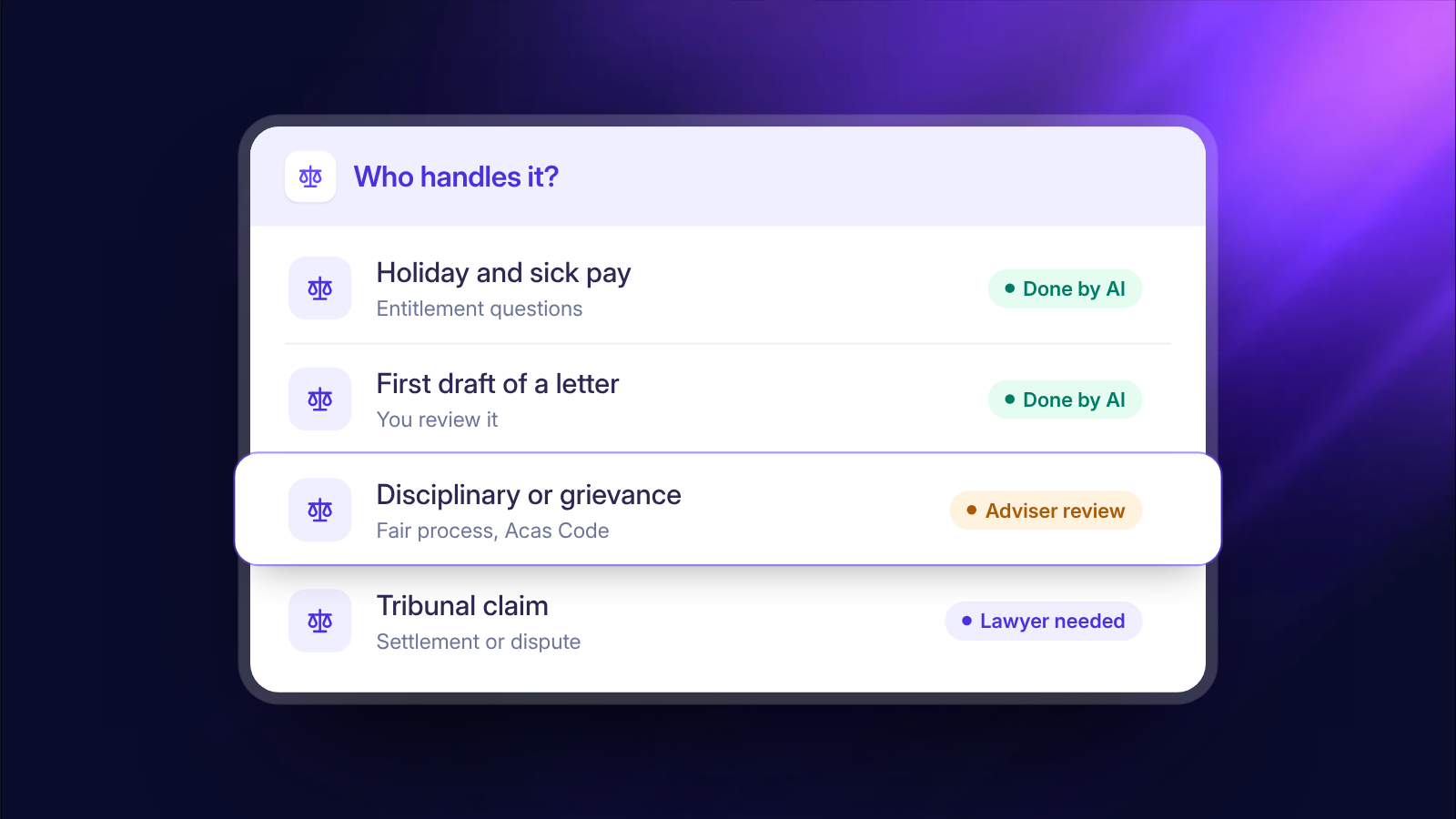
Many small UK employers no longer need to pay an HR adviser to answer everyday questions, because AI tools can now answer them from UK law, Acas guidance and your own policies. You still need a qualified person for dismissals, discrimination complaints, redundancies, settlement agreements and anything heading to a tribunal. The smart move for most businesses is to let AI handle the routine and save human advice for the cases that carry real risk.
Here’s how to work out which questions fall where, what each option costs, and why the employment law changes coming in 2027 make that line more important, not less.
Key takeaways
- There’s no legal requirement for a UK business to have an HR adviser. The question is how much risk you can manage without one.
- AI can now handle routine HR questions, such as entitlements, policy checks and first drafts of letters, if it uses UK law and your own documents.
- Get human advice for dismissals, discrimination, whistleblowing, redundancies, TUPE, settlement agreements and tribunal claims.
- From 1 January 2027, employees can claim unfair dismissal after 6 months’ service instead of 2 years, so more decisions will need careful handling.
- Acas gives free advice on 0300 123 1100, Monday to Friday, 8am to 6pm.
What does an HR adviser actually do?
An HR adviser helps an employer handle people issues correctly and fairly. For a small business, that usually means four kinds of work:
- Answering questions: holiday entitlement, sick pay, family leave, notice periods, right-to-work checks.
- Writing documents: contracts, handbooks, policies, letters for disciplinaries and grievances.
- Guiding a process: making sure a disciplinary, grievance or redundancy follows the Acas Code and your own policy.
- Making judgement calls: weighing up risk in a difficult case, handling sensitive conversations, and knowing when to bring in a lawyer.
The first two are where AI has changed the picture. The last two are where an experienced person still matters most.
How much does an HR adviser cost in the UK?
Costs vary a lot by model. These are the figures the providers themselves publish:
| Option | Typical cost | Typical monthly cost for a 10-person company | Source |
|---|---|---|---|
| Acas helpline | Free advice (call charges may apply) | £0 | Acas |
| HR software with an advice line (BrightHR Enhanced HR support) | From £21.20 per employee per month | From about £212 | BrightHR pricing |
| Outsourced HR and employment law service (Croner Employment Services) | From £34.06 per employee per month, based on 5 employees | About £341 (at the 5-employee rate) | Croner pricing |
| Outsourced HR retainer, 10 employees | About £157 a month on average, according to Peninsula’s own guide | About £157 | Peninsula guide |
| Contract HR consultant | Median £525 a day (May–Nov 2026) | £525 for each day of work you buy (e.g. one day a month) | ITJobsWatch |
The 10-person column is our own calculation from each provider’s published starting price, so the quote you get may differ.
Watch contract length as well as price. Citation, for example, says its contracts run for up to seven years, with three- to five-year terms also available.
What AI can now handle well
AI is good at HR questions that have a clear answer in the law or in your own documents. The best tools read your policies and contracts as well as UK guidance, show where each answer came from, and leave the decision to you. That covers a large share of what small businesses used to call their adviser about:
- Working out holiday entitlement, pro-rata leave, statutory sick pay and family leave.
- Checking what your own handbook says about lateness, absence or expenses.
- Explaining the steps of a fair disciplinary or grievance process under the Acas Code.
- Drafting a first version of an invitation letter, a return-to-work note or a policy for you to review.
- Reminding managers of deadlines, such as probation reviews or fit note end dates.
The Law Society warns that generative AI can produce answers that sound right but are wrong, and that a person stays responsible for checking them. The CIPD also advises keeping human oversight and clear routes to escalate. So the test for any AI HR tool is simple: does it show its sources, and does it tell you when to stop and get help?
When you still need a person
Get advice from an experienced HR professional or employment lawyer whenever a decision could end someone’s job, involve a protected characteristic, or lead to a claim. In particular:
- Dismissals, especially once the unfair dismissal qualifying period drops to 6 months in January 2027.
- Discrimination, harassment or whistleblowing complaints. There is no cap on compensation for discrimination, and since 30 October 2026 employers must take all reasonable steps to prevent sexual harassment.
- Redundancies, especially if 20 or more people could be affected.
- TUPE transfers, when staff move with a business or contract.
- Settlement agreements. The employee must get advice from an independent adviser for the agreement to be valid.
- Any tribunal claim or Acas early conciliation.
- Sensitive conversations about health, bereavement or performance, where how you say something matters as much as what you say.
Why the 2026–2027 law changes raise the stakes
The Employment Rights Act 2025 is coming into force in stages. According to the government’s implementation timeline (updated 5 November 2026):
| Date | Change |
|---|---|
| 6 April 2026 | Day-one paternity leave and unpaid parental leave; SSP paid from the first day of sickness |
| 1 October 2026 | Time limit for most employment tribunal claims extended from 3 to 6 months |
| 30 October 2026 | Duty to take all reasonable steps to prevent sexual harassment, including by third parties |
| 1 January 2027 | Unfair dismissal qualifying period cut to 6 months; cap on the compensatory award removed |
| March 2027 | New protections against fire and rehire |
| April 2027 | Changes to collective redundancy thresholds; new bereavement leave, including pregnancy loss |
Two numbers explain why this matters. The compensatory award for unfair dismissal is capped at £123,543 from April 2026, and that cap is due to go from January 2027. A tribunal can also raise an award by up to 25% if an employer unreasonably fails to follow the Acas Code of Practice. Read our guide to the unfair dismissal changes in 2027 for what to do now.
AI, HR adviser or employment lawyer? A quick guide
| Situation | AI HR tool | HR adviser | Employment lawyer |
|---|---|---|---|
| Holiday, sick pay or leave entitlement | Yes | If unsure | No |
| What does our policy say about X? | Yes | No | No |
| First draft of a letter or policy | Yes, you review it | To check | No |
| Running a disciplinary or grievance | To plan the steps | Yes | If it may lead to dismissal or a claim |
| Dismissal | To prepare | Yes | If there’s any risk of a claim |
| Discrimination, harassment or whistleblowing | To record facts | Yes | Yes |
| Redundancy of 20+ staff, or TUPE | To prepare | Yes | Yes |
| Settlement agreement or tribunal claim | No | Yes | Yes |
How to use AI for HR advice safely
- Check the sources. Use a tool that shows which law, Acas guidance or policy each answer came from.
- Ground it in your documents. General AI chat tools don’t know your contracts or handbook.
- Keep data in the right place. Don’t paste employee details into free tools. Check where the vendor hosts data and whether it trains models on it.
- Keep a record. An audit log of questions and answers helps if a decision is challenged later.
- Keep a person in charge. AI should prepare the work; a manager makes the decision.
- Know your escalation point. Decide in advance which cases always go to an adviser or lawyer.
Where Sense HR’s Counsel fits
Counsel is the HR advice agent in Sense HR. It answers HR questions using gov.uk guidance, Acas codes, statutory rates and case law, together with your own policies, handbooks, each employee’s contract and live HR data such as attendance and fit notes. Every answer comes with its sources and suggested next steps, and Counsel keeps an audit log you can export.
Counsel also knows its limits. It tells you when a case needs an employment lawyer, for example a large-scale redundancy, and can prepare a brief for them. It is not a replacement for an HR adviser or employment lawyer. What it changes is how often you need one, and how quickly they can help when you do.
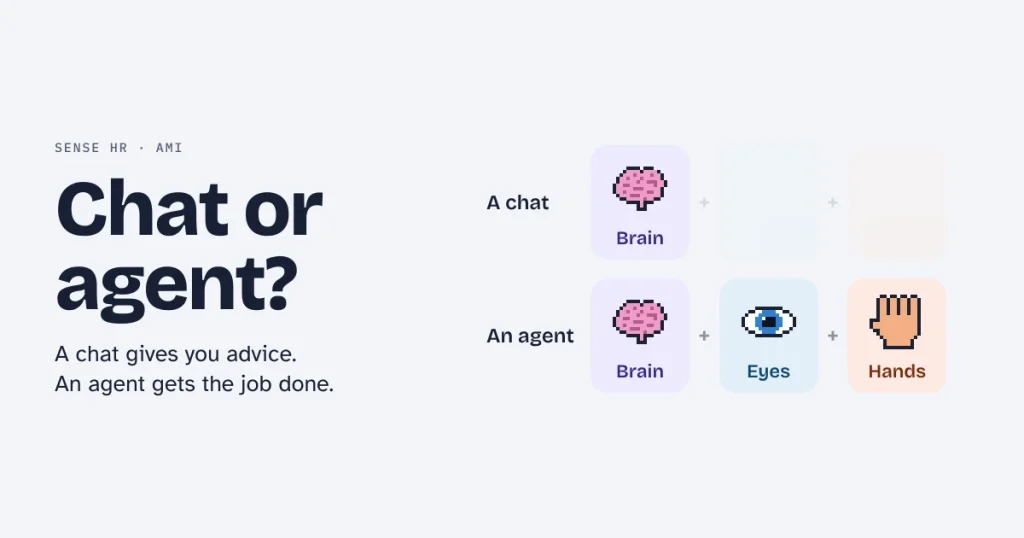
Counsel is part of AMI, Sense HR’s AI assistant, and is included on the Elite and Enterprise plans (see pricing). All data is hosted in the UK and is never used to train AI models. To see the difference between a general chat tool and an agent like Counsel, read Chat or agent? How AI agents differ from chatbots in HR.
Book a demo and ask Counsel one of your own HR questions.
Frequently asked questions
Does a small business legally need an HR adviser?
No. There’s no legal requirement for a UK business to have an HR adviser, but the employer is still responsible for following employment law. Many small businesses use free Acas guidance, HR software or an outsourced service instead of employing someone.
Can AI replace an HR adviser?
AI can replace a lot of routine HR questions and first drafts, especially when it uses UK law and your own documents. It can’t replace human judgement in dismissals, discrimination complaints, redundancies or tribunal claims, so most businesses still need access to an adviser or employment lawyer for those.
How much does an HR adviser cost in the UK?
Published prices range from free Acas advice, to HR software with an advice line from about £21 per employee per month, to outsourced HR services from about £34 per employee per month. Contract HR consultants charged a median of £525 a day in 2026.
Is Acas advice free?
Yes. Acas gives free employment advice on 0300 123 1100, Monday to Friday, 8am to 6pm, although you may be charged for the call. You must also contact Acas for early conciliation before most employment tribunal claims.
When do I need an employment lawyer instead of an HR adviser?
Get an employment lawyer when there’s a real risk of a tribunal claim, when an employee raises discrimination or whistleblowing, for settlement agreements, and for large redundancies or TUPE transfers. An HR adviser can usually help you run the process and tell you when legal advice is needed.
Is Counsel included in Sense HR?
Counsel is included, with the AMI assistant and Sense HR’s other AI agents, on the Elite and Enterprise plans. It isn’t part of the Team plan.
This article gives general information about UK employment law as of November 2026. It isn’t legal advice. Get advice on your own situation from Acas, a qualified HR professional or an employment lawyer.