A supervisor should not have to choose between trusting a handwritten timesheet and chasing staff for evidence after a payroll query. In the RFID badges versus QR check-ins decision, RFID is usually the stronger option where verified presence, recurring attendance and location-aware workflows matter. QR check-ins are often quicker and cheaper to introduce, but they depend more heavily on process discipline and the evidence they can provide is narrower.
The right choice depends on the decision your organisation needs to make. Is the aim simply to record that a worker started a shift? Or must operations confirm who attended a particular site, whether a scheduled task was completed, where to focus an emergency roll-call, or whether paid hours match recorded attendance?
What is the difference between RFID and QR check-ins?
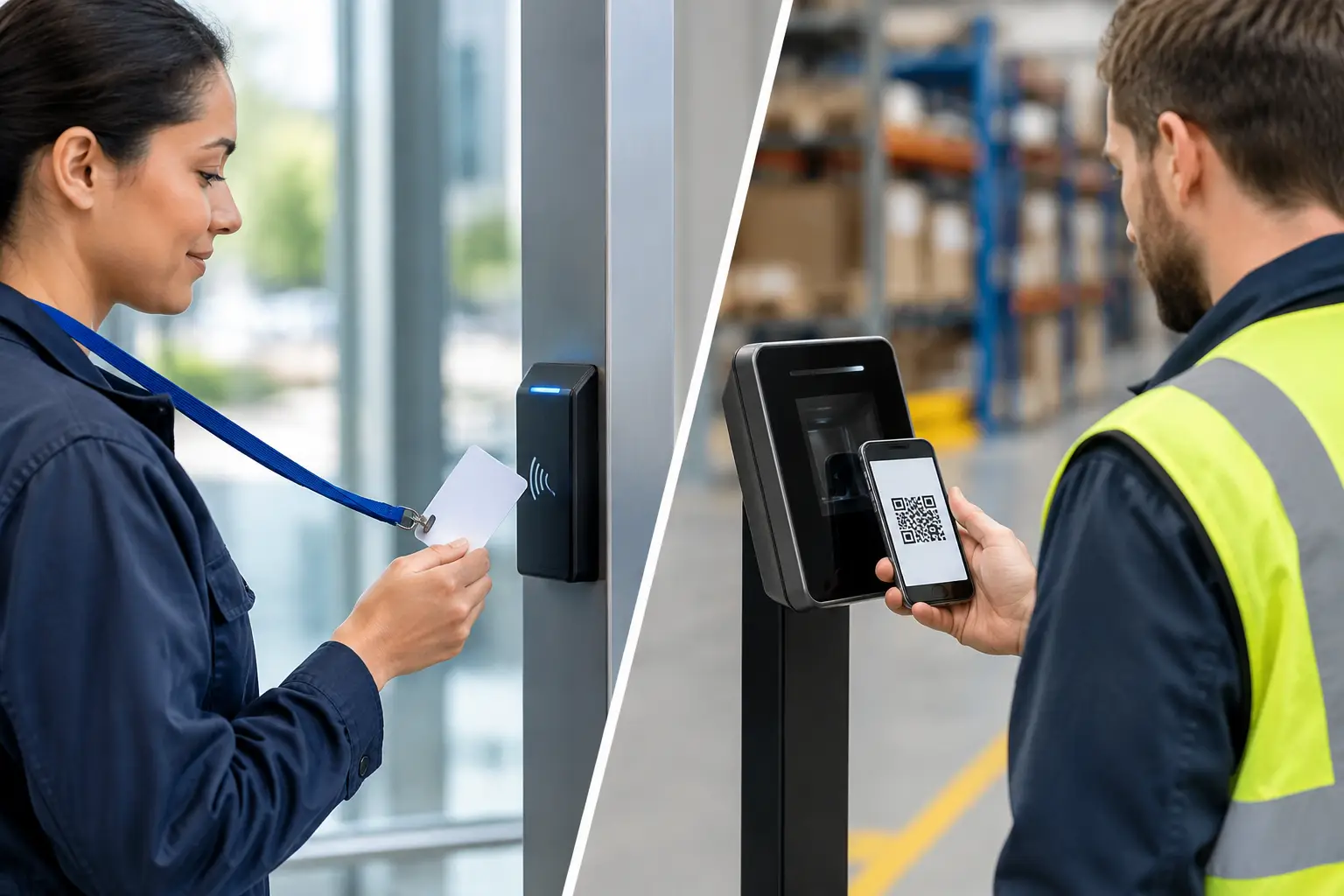
A QR check-in asks a worker to scan a printed or on-screen Quick Response code, normally with a smartphone. The scan can trigger a timestamped attendance record, task form or site visit confirmation. It is a straightforward digital replacement for paper sign-in sheets in many settings.
Radio-frequency identification, or RFID, uses a badge, card, tag or wearable containing a chip. A reader, clock, gateway or other compatible hardware detects the badge when it is presented or comes within the required reading range. The resulting event can record an identity, time and defined location or checkpoint, depending on the hardware and system design.
Neither method automatically proves every aspect of work. A QR scan proves that a device scanned a code at a given time. An RFID event shows that a specific badge was read at a defined point. If a badge is shared, or a code is photographed and used elsewhere, the record may not establish that the named worker personally performed the work. Controls must match the risk.
RFID badges versus QR check-ins for attendance
For fixed workplaces with a small number of occasional visitors, QR can be a sensible starting point. Put a code at the entrance, ask people to scan on arrival and departure, and send exceptions to a manager. There is little dedicated hardware to install, and new sites can be configured quickly.
That approach becomes less dependable when shifts are busy, workers move between sites, phones are not consistently available, or supervisors need a clear attendance view without relying on everyone to remember a scan. A damaged poster, poor mobile signal, flat battery or busy start-of-shift period can quickly create gaps that payroll and operations must resolve later.
RFID badges are better suited to repeated, high-volume attendance. Workers use the same physical credential at a clocking point or access location. The system records a consistent event format, which can feed timesheet checks, exception workflows and payroll review. The process is familiar for deskless teams and does not require a personal smartphone.
The operational benefit is not just speed at the door. It is the ability to compare planned shifts, recorded attendance and approved amendments in one workflow. Where an employee misses a clock-in, arrives outside the planned window or appears at an unexpected site, the system can flag the discrepancy for an appropriate person to review.
Evidence quality matters more than the technology label
The most useful question is: what does each event need to prove?
For a retail colleague clocking in at their home store, a badge read at a fixed clock may provide sufficient evidence. For a mobile cleaner arriving at a customer site, a QR code positioned at the location may provide practical proof of visit, especially when paired with a task record. For a lone worker in a large or changing environment, the organisation may require a different combination of wearable, gateway, location intelligence and safety process.
A single QR scan or badge tap should not be treated as proof that an entire shift was worked. Equally, continuous location data is not always necessary to manage attendance properly. Good workforce design collects the minimum data needed to support a defined operational action.
Where QR check-ins work well
QR check-ins are effective when deployment speed and low infrastructure requirements outweigh the need for stronger automated presence evidence. They suit temporary sites, occasional audits, visitor procedures, contractor inductions and simple task checkpoints.
They can also support proof-of-service workflows. A worker scans the code at a room, asset or site, then completes a checklist, records an issue or adds supporting information. The scan anchors the task in time and to a named location marker.
However, QR controls require careful design. Static codes can be copied, photographed or scanned by the wrong person. If the workflow relies on a phone, managers must account for device access, connectivity, battery life and the practical reality of workers wearing gloves or moving between duties. Dynamic codes, short validity windows and manager exception reviews may reduce some risks, but increase operational complexity.
Where RFID badges are the better fit
RFID is usually the stronger choice where attendance is frequent, workforce volume is high or site processes need consistent physical-world events. Typical examples include warehouses, manufacturing facilities, hospitals, hospitality venues and multi-site facilities management operations.
A badge can support more than a start and end time. With the right workflow, it can identify attendance at a zone, confirm arrival at a checkpoint, support site-specific rules and provide inputs to emergency response processes. Hardware placement matters: an event at the main entrance tells a different story from one at a work area or equipment store.
RFID also avoids making personal smartphones a condition of clocking in. That can be valuable for organisations with shared devices, restricted-phone areas or teams who should not need to use their own handset for a basic attendance action.
The trade-off is implementation. Badges must be issued and replaced, readers or clocks must be positioned and maintained, and site teams need clear procedures for lost credentials and exceptions. RFID is not automatically a location system either. A reader detects a badge at its designed checkpoint; more detailed real-time location requires appropriate location technology, coverage and governance.
Compare the operational trade-offs
| Decision area | QR check-ins | RFID badges |
|---|---|---|
| Initial deployment | Fast where workers have suitable phones and codes can be placed securely | Requires badges and compatible reading hardware |
| Attendance evidence | Timestamped scan at a code, subject to process and device controls | Timestamped badge event at a defined reader or clock |
| High-volume shift changes | Can create queues or missed scans if phones are slow or unavailable | Usually more consistent for repeated clocking routines |
| Mobile or temporary sites | Easy to deploy and move | May require portable or additional hardware |
| Task validation | Useful for linking a scan to a form or checklist | Useful at defined checkpoints where badge reads fit the task flow |
| Fraud and error controls | Static codes can be shared or copied | Badges can be shared or lost; controls still matter |
| Safety and roll-call inputs | Can show a recorded check-in but is limited by scan compliance | Can supply more regular site-entry events, depending on deployment |
How to choose the right check-in method
Start with the operational decision, not the preferred device. Map the moments where evidence is needed: shift start, shift end, arrival at a customer location, task completion, zone entry, welfare check or evacuation. Then define what the organisation must know at each point, how quickly it must know it and who will act on an exception.
Next, assess the environment. Consider mobile coverage, whether personal phones are suitable, the number of entry points, workforce turnover, gloves or PPE, site layout and the impact of a missed event. A small field team may value the flexibility of QR. A distribution centre with several shift handovers may value a consistent badge process far more.
Finally, test the workflow end to end. A check-in is only useful if it flows into timesheet review, task management, payroll checking, safety escalation or a manager dashboard without creating another manual spreadsheet. Sense HR can bring together workforce software and purpose-built workplace hardware where organisations need attendance and physical-world events to inform wider operational workflows.
Privacy, fairness and emergency use
Attendance data should have a clear purpose that workers can understand. Explain what is collected, where it is collected, who can see it, how long it is retained and how records can be challenged or corrected. In UK workplaces, teams should involve the right HR, data protection and employee representatives early, particularly where location data or safety monitoring is proposed.
Avoid describing any attendance system as surveillance by default. A well-designed process is about resolving practical questions: who is on site, which hours need approval, whether a service visit occurred and whether someone may need support. Collecting more granular data than the use case requires can damage trust without improving control.
For fire and emergency roll-calls, badge or QR records are supporting information, not a substitute for trained marshals and site procedures. Entry data may help create an initial list, but it cannot guarantee that every person remains inside or has safely reached an assembly point. The response plan must account for visitors, contractors, missed scans and changing conditions.
Frequently asked questions
Are RFID badges more secure than QR codes?
They can provide stronger control at a fixed, managed checkpoint, but neither method is inherently fraud-proof. Badge sharing, lost cards, copied QR codes and missed scans all need operational controls, exception reporting and proportionate review.
Can QR check-ins be used for payroll?
Yes, if the organisation is comfortable with the evidence collected and has a process for approving exceptions. QR data should be checked against planned shifts and authorised changes rather than passed automatically into pay without review.
Do RFID badges track workers continuously?
Not necessarily. A standard RFID attendance setup may only record a badge at specific readers or clocks. Continuous or near-real-time location requires separate technology design, suitable hardware coverage and a clearly defined purpose.
Should we use both QR and RFID?
Many organisations do. RFID may handle regular site attendance, while QR supports temporary locations, visitor processes or task-specific proof of service. Use each method where its evidence and operational burden make sense.
The better check-in method is the one that gives managers timely, proportionate evidence and gives workers a clear, workable process. Build it around the decision that follows the event, and the data will do more than mark a time on a timesheet.