
Holiday entitlement looks straightforward when everyone works 40 hours a week. But UK holiday rules for employers get more complicated when someone works three days a week, changes their shift, or joins halfway through your leave year. And then you have to consider things like holiday pay, annual carry-over, and where you’re going to store all the evidence.
This guide explains the main UK holiday rules for employers, shows how to apply them and gives you a practical record-keeping checklist. The detailed reforms discussed below apply to Great Britain: England, Wales and Scotland. Northern Ireland has separate rules, explained in its own section.
At a glance: most workers have a statutory entitlement of 5.6 weeks. However, the calculation depends on their working arrangement. Also, holiday entitlement and holiday pay are separate calculations. Since 6 April 2026, employers in Great Britain must retain adequate holiday records for six years from when they were made. Software can help organise this work. However, the employer remains responsible for applying the right rules.
UK holiday rules for employers in 2026: key facts
- Statutory entitlement is 5.6 weeks of paid leave, capped at 28 days (GOV.UK).
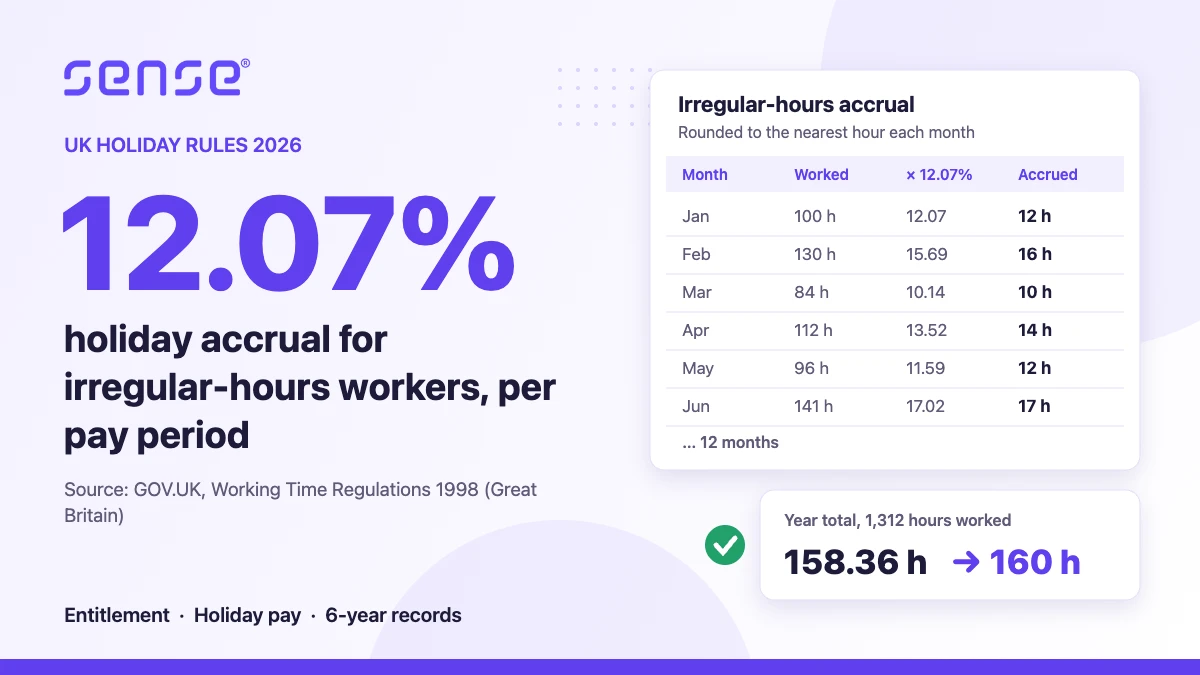
- Qualifying irregular-hours and part-year workers in Great Britain accrue statutory leave at 12.07% of hours worked in each pay period, for leave years starting on or after 1 April 2024.
- Accrual is rounded per pay period: under 30 minutes rounds down, 30 minutes or more rounds up. Over a year, that rounding can move the total by more than an hour (see our 12-month worked table below).
- Since 6 April 2026, employers in Great Britain must keep adequate holiday and holiday-pay records for six years from when each record was made (regulation 16B, Working Time Regulations 1998).
- Northern Ireland has separate legislation: the 2024 accrual reforms and the April 2026 record duty do not automatically apply there.
How much paid holiday must employers give under UK rules?
Almost all workers are entitled to 5.6 weeks of paid annual leave. For example, for someone working five days a week, that means 28 days. Statutory entitlement is capped at 28 days, so a six-day working week does not produce 33.6 statutory days. However, employers can offer more through the contract. See GOV.UK’s holiday entitlement guidance.
In practice, this means keeping statutory and additional contractual leave identifiable in your records. This is because they can have different rules, particularly around carry-over and selling unused days. For instance, a policy offering 30 days should explain how that allowance relates to bank holidays, rather than leaving employees to guess.
Are bank holidays included?
In general, bank holidays can count towards statutory entitlement. However, there is no automatic right to have them off or receive extra pay for working them; check the employment contract. For 2026, the national calendars contain eight bank holidays in England and Wales, ten in Scotland and ten in Northern Ireland. Scotland’s total includes the additional 15 June World Cup holiday.
Use the official UK bank holiday calendar and the Scottish Government’s 2026 dates. Therefore, do not reuse last year’s count without checking. Similarly, a new bank holiday does not automatically increase everyone’s contractual allowance: the contract wording matters.
Start by identifying the worker’s arrangement
The first question is not which percentage to use. Instead, it is which rules apply to the worker. For example, a rotating shift pattern is not necessarily an irregular-hours arrangement.
| Arrangement | What to establish | Calculation approach |
|---|---|---|
| Regular full-time hours | Working days or hours per week and contractual allowance | Calculate annual entitlement from the regular working pattern. |
| Regular part-time hours | Normal days and the length of each working day | Apply the appropriate pro-rata entitlement. Use hours where unequal days would make a days-based allowance confusing. |
| Fixed rotating shifts | Whether contractual hours are fixed over the rota cycle | Do not assume the irregular-hours method applies simply because one week differs from another. |
| Irregular hours | Whether paid hours are wholly or mostly variable under the contract | For qualifying arrangements, accrue statutory leave at 12.07% of hours worked in each pay period. |
| Part-year work | Whether the contract includes periods of at least a week when no work is required and no pay is due for that period | Apply the qualifying part-year rules, rather than treating every term-time worker identically. |
The revised accrual rules apply to qualifying leave years beginning on or after 1 April 2024. In addition, contract terms and actual arrangements matter. Read the definitions in the government’s holiday reform guidance before changing a worker’s calculation method.
Four worked holiday examples
These are illustrative calculations, not customer cases. They also assume statutory minimum entitlement unless stated otherwise.
Example 1: a regular three-day working week
Priya works three equal-length days each week throughout the year. Her statutory allowance is:
3 days × 5.6 weeks = 16.8 days.
If each day is eight hours, that is 134.4 hours. Also, recording the allowance in hours can make part-day bookings easier to administer. However, do not round the entitlement down to 16 days. Instead, decide how any fractional day will be booked, and explain that clearly.
Example 2: irregular hours and statutory rounding
Alex qualifies as an irregular-hours worker and works 100 hours in a monthly pay period:
100 × 12.07% = 12.07 hours before rounding.
The statutory accrual calculation rounds fractions below 30 minutes down and fractions of 30 minutes or more up to the nearest hour. Alex therefore accrues 12 hours in this example. Similarly, at 130 hours worked, the calculation is 15.691 hours, which rounds to 16 hours.
However, this specific rounding rule should not be confused with rounding a regular part-time employee’s annual allowance down. Also, if the contract provides more than statutory minimum leave, the accrual percentage needs adjusting. See Acas’s irregular-hours accrual guidance.
What per-period rounding does over a full year
Because accrual is rounded in every pay period, an irregular-hours worker’s annual total can differ from a single annual calculation. For example, in this illustrative 12-month pattern, Alex works 1,312 hours. One calculation at year end gives 158.36 hours; adding up the rounded monthly accruals gives 160 hours, 1.64 hours more.
| Month | Hours worked | 12.07% accrual | Rounded accrual |
|---|---|---|---|
| Jan | 100 | 12.070 | 12 |
| Feb | 130 | 15.691 | 16 |
| Mar | 84 | 10.139 | 10 |
| Apr | 112 | 13.518 | 14 |
| May | 96 | 11.587 | 12 |
| Jun | 141 | 17.019 | 17 |
| Jul | 73 | 8.811 | 9 |
| Aug | 118 | 14.243 | 14 |
| Sep | 104 | 12.553 | 13 |
| Oct | 126 | 15.208 | 15 |
| Nov | 90 | 10.863 | 11 |
| Dec | 138 | 16.657 | 17 |
| Year | 1,312 | 158.358 | 160 |
The practical lesson: calculate and record accrual in each pay period, not once a year. Otherwise, a year-end recalculation will not match what the worker has been told, and the six-year record duty means the per-period figures are the evidence you need to keep. The direction and size of the difference depend on the hours pattern; it can also be negative.
Example 3: rolled-up holiday pay
Jordan qualifies for rolled-up holiday pay and earns £1,200 gross in the pay period before holiday pay. Assuming statutory minimum leave:
£1,200 × 12.07% = £144.84 holiday pay.
As a result, the total gross payment is £1,344.84, with £144.84 shown separately as holiday pay. In other words, the holiday payment is additional to ordinary earnings, not carved out of them. However, Jordan must still be allowed to take time off; paying the money does not remove the leave entitlement. See Acas’s rolled-up holiday pay guidance.
Example 4: a starter halfway through the leave year
Sam works five equal-length days a week and joins on 1 July. The employer’s leave year is 1 January to 31 December and its policy uses a monthly pro-rata calculation. With 28 days for a full year:
28 × 6 ÷ 12 = 14 days for July to December.
This example assumes six complete months and no enhanced contractual allowance. By contrast, a mid-month start, different leave year or different permitted accrual arrangement requires a more precise calculation. Therefore, record the start date, method and bank holiday treatment rather than copying “14 days” into every starter’s record. Use the GOV.UK holiday calculator for the relevant arrangement.
Holiday entitlement and holiday pay are different
Entitlement tells you how much time off someone has. In contrast, holiday pay tells you what they receive for it. Consequently, an accurate leave balance does not prove the payment is correct.
For regular-hours workers in Great Britain, at least four weeks of statutory leave must be paid at normal pay, including relevant regular overtime, commission and other qualifying payments. The remaining 1.6 weeks can be paid at basic pay, unless the contract provides more. Alternatively, an employer can choose to pay all statutory leave at the normal rate.
For qualifying irregular-hours and part-year workers under the reformed rules, all statutory leave is paid at the normal rate. Employers can use permitted rolled-up holiday pay or pay when leave is taken. Therefore, do not apply the four-week/1.6-week split indiscriminately.
Where a 52-paid-week reference period is required, unpaid weeks are excluded and the lookback can extend to 104 weeks. Also, a shorter employment history needs its own treatment. In either case, payroll should document the weeks and earnings included. See GOV.UK’s holiday pay calculations.
When must employers let unused holiday carry over under UK rules?
A standard policy might limit ordinary carry-over, but it cannot override statutory protections. For this reason, record why the leave was not taken before applying a cap or deleting a balance.
| Reason | Regular-hours workers in Great Britain | Qualifying irregular-hours and part-year workers |
|---|---|---|
| Long-term sickness prevents leave | Up to four weeks of statutory leave; use within 18 months of the end of the leave year in which it accrued. | Accrued, unused statutory leave, up to 5.6 weeks; the 18-month deadline applies. |
| Statutory family leave prevents leave | Unused statutory entitlement must be allowed to carry into the next leave year. | Accrued, unused statutory entitlement must be allowed to carry into the next leave year. |
| Employer fails to enable or encourage leave, or warn that it will expire | Carry-over protection can cover up to four weeks. Do not apply an ordinary policy expiry without checking the circumstances. | Protection can cover accrued, unused statutory entitlement up to 5.6 weeks. |
| Ordinary carry-over by agreement | Subject to the applicable statutory limits and a relevant agreement; additional contractual leave follows the contract. | A relevant agreement can permit carry-over; additional contractual leave follows the contract. |
For the detail, use Acas’s separate guidance on general holiday carry-over and irregular-hours and part-year carry-over. In particular, employer-failure cases need care: sending a reminder is not a substitute for making leave genuinely possible.
What holiday records do UK rules require employers to keep from April 2026?
From 6 April 2026, employers in Great Britain must keep adequate holiday entitlement and pay records for six years from the date each record was made. This includes leave taken, carry-over, holiday pay and relevant payments in lieu. The duty is set out in regulation 16B of the Working Time Regulations.
A reasonable spreadsheet or payroll system can be used; dedicated HR software is not compulsory. Above all, the practical test is whether your records explain what happened and how you calculated it. Moreover, failure to keep adequate records can lead to criminal enforcement. Read Acas’s current record-keeping guidance for the enforcement position.
A practical holiday record example
For Alex’s illustrative 100-hour month, retain the following connected information. This is a suggested operational record, not a prescribed government form.
| Record | Example entry or evidence |
|---|---|
| Worker and period | Employee identifier, relevant leave year and monthly pay period |
| Calculation basis | Qualifying irregular-hours arrangement; statutory minimum allowance |
| Approved hours | 100 hours, linked to the approved timesheet |
| Accrual | 100 × 12.07% = 12.07; rounded entitlement: 12 hours |
| Leave activity | Dates and hours actually taken, approvals and any corrections |
| Pay evidence | Chosen holiday-pay method, relevant earnings and payroll reference |
| Exceptions | Carry-over reason, applicable deadline and supporting decision |
| Record management | Creation date, access permissions and retention arrangements |
After all, a holiday booking history alone may not include the payroll evidence. As a result, make sure HR and payroll records can be reconciled, including after someone leaves or you change suppliers.
What is different in Northern Ireland?
Northern Ireland has its own working time legislation. Consequently, do not automatically apply Great Britain’s 2024 accrual reforms or April 2026 record-keeping amendment to Northern Ireland workers.
Nidirect’s current guidance describes holiday pay for variable earnings using a 12-week reference period and says rolled-up holiday pay should not be included in the hourly rate. Use Northern Ireland’s holiday-pay guidance and holiday entitlement guidance when setting up those workers.
If you employ people across jurisdictions, identify the applicable rules in each record. Of course, a single company policy can offer a consistent enhanced benefit, but the underlying legal calculations and evidence requirements still need checking.
A year-end checklist for employers on UK holiday rules
- Reconcile balances. Compare approved leave with leave actually taken and correct errors before closing the year.
- Contact people with unused leave. Explain their balance, booking options and the consequences of not using it.
- Check whether leave is realistically available. For instance, repeated refusals or persistent understaffing need attention, not another automated reminder.
- Review exceptions individually. Separate sickness, statutory leave, employer-failure cases and ordinary contractual carry-over.
- Check payroll. Confirm the appropriate pay components and reconcile any starter or leaver adjustments.
- Preserve the evidence. Keep calculations, communications and decisions accessible under your retention and access policies.
Where Sense HR helps employers with UK holiday rules
Sense HR’s holiday and leave management supports entitlement calculations, configurable allowances, approval chains, carry-over settings and calendars. In addition, managers can approve through email, Slack, mobile or the dashboard. Furthermore, regional bank holiday settings and custom leave types help teams with different arrangements.
The useful buying test is a real example. First, ask the supplier to show a part-time employee, a qualifying irregular-hours worker and a protected carry-over case. Then check what appears in the leave history, what payroll receives and what can be exported later.
Next, use policy controls carefully. For example, a setting that blocks dates or expires a balance should reflect the worker’s rights and your contract. Finally, confirm that the combined HR and payroll records cover the evidence you need; do not assume the booking screen contains everything.
For more calculation detail, see our holiday entitlement guide. If you are comparing tools, read what to look for in holiday management software.
FAQs: UK holiday rules for employers
Can an employer refuse a holiday request?
Yes, but the notice and contractual rules matter. GOV.UK describes the general refusal or cancellation notice as the requested leave duration plus one day. Employers must still enable workers to take their statutory entitlement. See the booking and notice rules.
Can workers sell unused holiday?
During employment, a buy-and-sell scheme should not reduce leave below the statutory minimum. Additional contractual days can be treated according to the scheme’s terms. Payment for accrued, untaken statutory leave when employment ends is a different situation.
What happens when someone leaves?
Calculate accrued entitlement and leave taken, then pay for outstanding statutory leave. A deduction for excess leave taken needs the appropriate contractual or written agreement. Keep the calculation with the final payroll record.
Do I need HR software to meet the record-keeping duty?
No. Complete, reliable records can be kept in a reasonable format. Software becomes useful when manual calculations, multiple approvers or disconnected payroll records make the process difficult to control.
See the holiday workflow with your own examples
Book a Sense HR demo and bring the working patterns you find hardest to manage. We can walk through entitlements, approvals and reporting. You can also start a free trial or watch the four-minute product tour.
Sources checked: 3 November 2026. This guide provides general information on UK holiday rules for employers, not advice on an individual employment dispute. Check the linked official guidance and the relevant contract before applying a rule to a specific case.