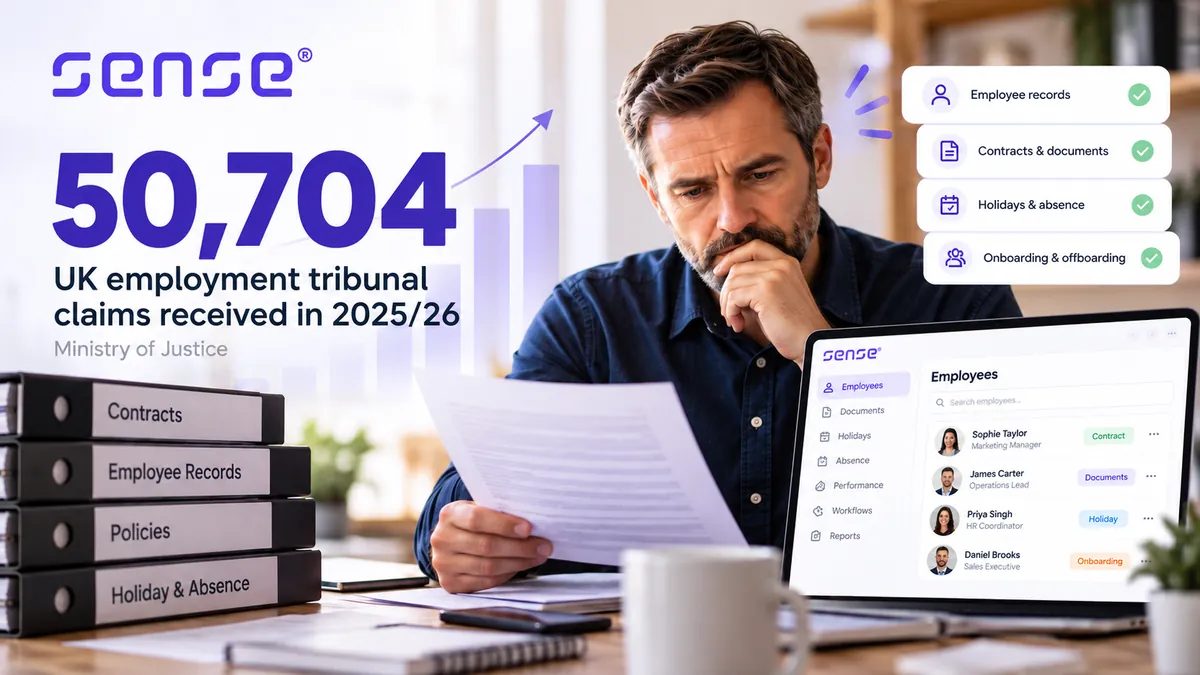
50,704 single employment tribunal claims were received in the UK during 2025/26. That is around 40% more than the previous year. For businesses defending a claim, the consequences can extend far beyond compensation.
A dispute might begin with holiday pay, working hours, missing documentation or a dismissal decision. If it escalates, an employer may face compensation, legal expenses, management disruption and reputational consequences.
For smaller UK organisations without dedicated HR or legal departments, the question is not simply whether HR administration is efficient. It is whether their processes and records are good enough when they matter most.
Employment tribunal claims in the UK: The 2026 figures
Ministry of Justice figures show a substantial rise in single employment tribunal claims received.
| Financial year | Single claims received |
|---|---|
| 2023/24 | 33,875 |
| 2024/25 | 36,171 |
| 2025/26 | 50,704 |
The number of single claims received rose by approximately 40% between 2024/25 and 2025/26. By the end of June 2026, approximately 70,000 single-claim cases remained open.
These figures concern the tribunal system as a whole. They do not imply that every claim succeeded, that every claim involved a different employer, or that any given business faces the same level of risk.
Sources: Ministry of Justice tribunal statistics; and Justice Data employment tribunal figures
How much can an employment tribunal cost an employer?
The cost depends on the claim, the case outcome, the employer’s legal and professional expenses and the time spent responding.
In the Ministry of Justice 2023/24 compensation data, the mean unfair dismissal award was £14,000, and the highest reported unfair dismissal award was £179,000. These figures relate to the stated historical reporting period, not the average cost of every claim in 2026.
The £14,000 average applies to cases where compensation was awarded. It is not the mean cost of all filed claims, nor does it include every expense of defending a case.
Costs beyond an award
- Legal and professional fees: advice and representation may increase the total cost.
- Management time: reviewing correspondence, locating documents and preparing evidence can draw managers away from the business.
- Operational disruption: disputes can affect internal confidence, relationships and leadership focus.
- Reputational exposure: many tribunal decisions are published on the public government register, subject to applicable restrictions.
A successfully defended claim can still consume resources, and not every claim produces compensation or substantial external costs.
Source: Ministry of Justice tribunal compensation reporting
A real employment tribunal case: £13,270 awarded
In Bloxham v Handling Equipment UK Limited (case 1300309/2025), a judgment dated 24 November 2025 ordered a total payment of £13,270.08.
| Component | Amount |
|---|---|
| Unfair dismissal basic award | £10,500.00 |
| Unfair dismissal compensatory award | £748.85 |
| Accrued but untaken holiday pay | £621.23 |
| Additional award relating to written employment particulars | £1,400.00 |
| Total | £13,270.08 |
This published example demonstrates how several employment obligations can be relevant within one dispute. The judgment does not demonstrate that inadequate HR software caused the issues, or that using Sense HR would have prevented the outcome.
Source: Official published judgment (PDF)
What businesses can learn from tribunal decisions
1. Holiday pay is more than an admin task
Holiday calculations can be disputed when staff leave, working patterns change or entitlement records are incomplete. Employers should apply the relevant rules and maintain reliable records of leave and outstanding entitlement.
A system that brings entitlements, requests and approvals together can make information easier to manage. Sense HR’s holiday and leave management software supports configurable entitlements, workflows and leave tracking.
Software does not replace the employer’s legal obligations, but it can support consistent administration.
2. Employment documents should be accessible
Contracts, written particulars, policy acknowledgements and employment changes should be organised rather than scattered across inboxes and folders.
Sense HR’s employee records software helps connect employee information with associated documents and HR history.
3. Consistent processes can reduce uncertainty
If different managers handle similar situations in different ways, records may vary substantially. Documented processes and clear responsibilities support more consistent administration while preserving room for judgement.
Learn more about HR automation and workflows and how structured processes can reduce administrative inconsistency.
4. Employee departures deserve particular attention
The end of employment may involve outstanding leave, final pay, documents, return of property and other obligations. A checklist can help make administrative responsibilities visible.
Sense HR’s offboarding workflow supports structured leaver administration, including prompts and relevant holiday information.
A workflow does not guarantee a legally compliant dismissal or final payment.
Can better HR processes help reduce employment risk?
Good processes cannot eliminate claims. An employer can maintain appropriate records and still face a dispute. But accurate information and consistent workflows help businesses review what happened, establish which steps were completed and respond when questions arise.
- Keep employee records and written documents organised.
- Review leave entitlements, working patterns and final-pay calculations carefully.
- Document important decisions and relevant employee communications.
- Apply policies consistently, taking individual circumstances into account.
- Seek qualified legal or HR advice when a specific employment-law issue arises.
For businesses relying on scattered tools, see our guide to fixing fragmented HR processes.
How Sense HR helps businesses manage HR with more confidence
Sense HR brings employee records, documents, holiday and absence management and recurring HR processes into one system. The goal is to help teams find information and follow established processes without relying on disconnected records.
- Employee records and associated documents
- Holiday entitlements and configurable approvals
- Absence administration and employee history
- Onboarding and offboarding workflows
- Structured HR recordkeeping
Explore Sense HR’s HR compliance features for document management, recordkeeping and related HR processes.
No software can guarantee protection from employment tribunal claims. Compliance depends on the law, the facts, the employer’s decisions and how procedures are applied.
Try Sense HR free for 14 days
Employment disputes are not something business owners want to spend time dealing with. Organised records and workflows cannot remove every risk, but they can provide a stronger administrative foundation.
Explore Sense HR with sample staff and workflows before deciding whether it fits your business. No payment card or sales call is required to start.
Start your free 14-day Sense HR trial
Frequently asked questions
How much does an employment tribunal cost an employer?
There is no one typical cost. It varies by claim, representation, outcome and award. The reported 2023/24 mean unfair dismissal compensation award of £14,000 refers only to relevant cases receiving an award, not every tribunal claim.
Are employment tribunal decisions public?
Many judgments can be found in the GOV.UK employment tribunal decisions register, subject to applicable publication restrictions.
Can a tribunal claim concern holiday pay?
Yes. Holiday pay disputes can form part of tribunal proceedings. The Bloxham judgment included an amount for unpaid accrued holiday entitlement.
Can HR software prevent tribunals?
No. Software can support organised records and consistent administration, but employers remain responsible for the decisions they take and the rules they must follow.
Why invest in an HR system?
A central system can make employee records, leave, documents and routine workflows easier to maintain as a business grows.
Editorial note: Statistics reflect government reporting available as of 26 October 2026 and refer to the separate periods stated. This article provides general information, not legal advice.