
A worker disputes a missed shift. The timesheet says they were absent, their manager believes they arrived late, and payroll needs an answer before cut-off. Can location data prove attendance? It can provide strong evidence that a person or authorised device was at a defined place at a particular time, but location data alone is rarely the complete answer. Reliable attendance evidence combines place, time, identity and a clear operational rule.
For frontline and multi-site organisations, that distinction matters. A GPS ping near a depot does not necessarily show that someone started work. A verified clock-in at the correct entrance, matched to a worker identity and scheduled shift, is far more useful when resolving a pay query or confirming site cover.
What location data can prove about attendance
Location data records where a device, badge or worker-associated token was detected. Depending on the technology, it may show an outdoor position, presence within a site boundary, entry into a specific zone, or proximity to a reader or gateway.
Used properly, it can establish several useful facts: a worker was detected at Site A; their arrival and departure fell within recorded times; they reached a required work area; or they were not at the location claimed on a timesheet. These records can make attendance conversations quicker and less subjective, especially where managers oversee several locations.
The strength of the evidence depends on the question. If the question is, “Was this employee at the warehouse during the scheduled shift?”, a site-level record may be sufficient. If it is, “Did the security officer complete the 22:00 patrol at the plant room?”, the organisation needs more precise, task-level evidence.
Attendance is not simply physical presence. Most policies also define what counts as the start of work, paid breaks, travel between sites, handovers and authorised exceptions. Location data supports those rules. It does not replace them.
Can location data prove attendance on its own?
Usually, no. It can corroborate attendance, but it cannot always prove that the right individual performed productive work for every minute recorded.
A mobile phone may be left in a vehicle or handed to another person. GPS can drift, particularly around large buildings, urban areas or covered loading bays. A geofence, which is a virtual boundary drawn around a location, can confirm approximate entry into a site but may not distinguish the reception area from a work zone. Indoor location technologies can provide a more detailed picture, but their usefulness still depends on how devices are issued, worn and maintained.
There is also a difference between presence and work. A worker may arrive on site early, remain after a shift for a personal reason, or be present for induction rather than their usual duties. Automatically converting every detection into payable time creates avoidable disputes.
The most defensible approach is to treat location as one evidence source within an attendance workflow. Identity confirmation, scheduled shift data, clock events, manager-approved exceptions and task records each add context. Together, they create a clearer account of what happened.
The evidence hierarchy: from a GPS signal to verified hours
Not all location records carry equal weight. Organisations should match the technology to the level of assurance required.
Mobile GPS and geofencing
GPS uses satellite signals to estimate a device’s outdoor position. It works well for mobile teams such as field engineers, delivery operations and staff travelling between customer sites. A geofence can trigger an arrival or departure event when the device crosses a site boundary.
This is useful for visibility and prompts, but it is best treated as approximate evidence. It may not be appropriate as the sole basis for payroll where the site boundary is tight, signal conditions are inconsistent or workers regularly travel through the area without beginning a shift.
Clock-ins and fixed readers
A workforce clock, card reader or badge scan creates a specific event at a known point. It is often more suitable for shift start and finish because it records an intentional action at the workplace.
However, a scan only proves that a credential was presented. Controls may be needed to prevent proxy clocking, where one person clocks in for another. Depending on the setting, identity checks, supervisor oversight or badge-based physical access records can strengthen confidence.
Indoor location and zone-level events
Real-time location systems, often called RTLS, use on-site hardware to detect tags, badges or wearables within a building or defined operational area. They can support higher-value workflows where knowing the exact zone matters, such as emergency roll-calls, restricted-area access, lone-worker response and proof that a required location was reached.
This is not automatically better for every organisation. It requires appropriate site design, issued devices and operational governance. For a small workforce at one predictable entrance, a well-managed clock may be the simpler choice. For a hospital, manufacturing site or dispersed facilities contract, zone-level intelligence may answer operational questions a conventional timesheet cannot.
Build an attendance process that stands up to scrutiny
The starting point is not the device. It is the attendance rule. Define the event that counts as attending work, then capture evidence that directly supports it.
For example, a logistics site might define shift attendance as a named worker completing an authenticated clock-in at their assigned depot, no more than a set period before the rostered start. A facilities provider may define attendance differently: arrival at the customer site, check-in at the designated service point and completion of the opening task.
A practical process should cover four areas:
- Identity: establish whose attendance is being recorded, using an assigned badge, authenticated device, clock method or another proportionate control.
- Place: define the site, entrance or work zone that is relevant to the role rather than collecting location data everywhere.
- Time: compare recorded events with the roster and make clear how early arrivals, breaks, travel and overtime are treated.
- Exceptions: give workers and managers a straightforward way to explain missed scans, faulty devices, authorised site changes and emergencies.
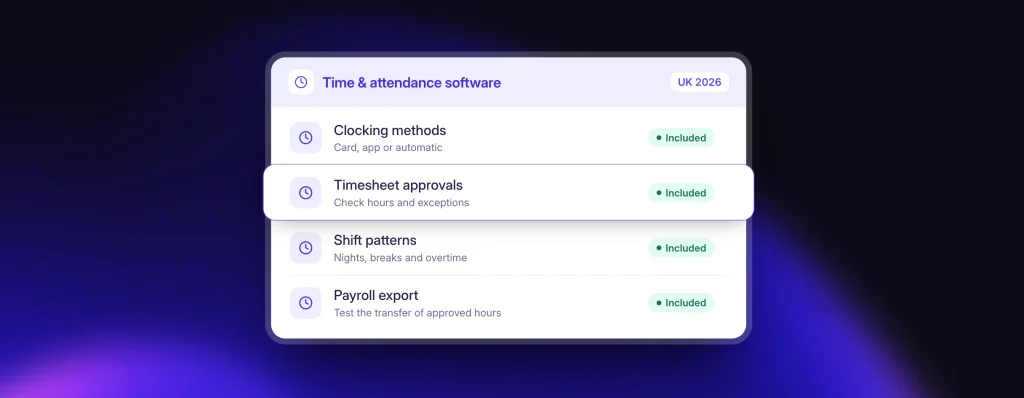
Exception handling is where many systems fail. A system that merely flags discrepancies transfers admin to payroll and line managers. A useful workflow routes the exception to the right person, retains the original evidence, records the decision and updates the approved timesheet without losing the audit trail.
Sense HR can bring together workforce scheduling, time and attendance, location-aware hardware and workflow automation so operational teams can use those events as evidence rather than isolated data points. The value is not a map on its own. It is the action that follows: verify a shift, prompt a missing check-in, confirm site cover or escalate a safety concern.
Privacy and fairness are part of evidence quality
Location monitoring affects people directly, so a technically accurate record can still create risk if the purpose is unclear or the collection is excessive. UK organisations should be able to explain what data they collect, why it is needed, when it is collected, who can see it and how long it is retained.
The principle of data minimisation is practical as well as privacy-conscious. Collect the least detailed information that answers the operational question. A worker who needs proof of arrival at one customer site may not require continuous location tracking throughout their day. Equally, a lone worker in a high-risk environment may need location and SOS capability because rapid response is part of the safety process.
Policies should distinguish work time from personal time, including the treatment of company devices outside shifts. Workers need clear notice, accessible guidance and a route to challenge inaccurate records. Managers also need training: location events are evidence to assess against the facts, not an automatic finding of misconduct.
Before implementation, involve operations, HR, payroll, health and safety, IT and data protection stakeholders. Review the purpose and proportionality of each use case, particularly where records may affect pay, performance management or disciplinary decisions.
Common attendance scenarios and the right level of proof
A retail manager checking whether enough colleagues arrived for opening may only need confirmed clock-ins and an alert for missing staff. A mobile maintenance business may need a geofence arrival event, a customer-site check-in and a service task completion record. A manufacturing supervisor may need evidence that trained staff entered a controlled area before work begins.
Emergency roll-call is different again. During an evacuation, the priority is an up-to-date view of who may still be on site, not retrospective payroll validation. Systems designed for this use need dependable site presence events, clear muster workflows and procedures for visitors, contractors and people whose badges were not detected.
The same data can support several workflows, but each workflow needs its own rules. Trying to use a single GPS event as proof of pay, task completion, safety compliance and performance is likely to produce poor decisions.
Questions to ask before relying on location records
Ask whether the system identifies the worker, not merely their device. Check the likely accuracy in the actual environment, including indoor areas and sites with poor signal. Establish what happens when the device battery is flat, a badge is forgotten or connectivity is unavailable.
Then test the workflow with real exceptions. Can a worker correct an error? Can a manager approve a legitimate variation? Does payroll receive an approved record rather than raw location events? Can the organisation explain the evidence behind a decision six weeks later?
Location data is most valuable when it removes uncertainty without creating a new layer of surveillance or administration. Design attendance around the operational fact that matters, capture proportionate evidence, and give people a fair way to resolve the exceptions that real work will always produce.