“Priya went home ill at 2pm. She doesn’t know when she’ll be back. What should we enter?”
It is an ordinary situation for managers and HR teams. Yet a system that insists on an End date can turn an unknown return into a string of guesses. The date gets moved. Notes accumulate. Sometimes a single illness ends up looking like several disconnected absences.
A more accurate sickness record should show what is known and leave what is unknown as unknown.
That is one of the main changes in Sense HR 7.0.
What is an open-ended sickness booking?
An open-ended Sickness booking is an absence recorded without a known End date. It stays open until the employee’s return is recorded.
This is different from inventing an expected return date simply to make a form save. One continuous absence can remain one record, even when its duration is uncertain.
Sense HR 7.0 supports open-ended Sickness, as well as full-day, half-day, quarter-day and time-based absence. Multi-day Sickness can also have a partial first or last day.
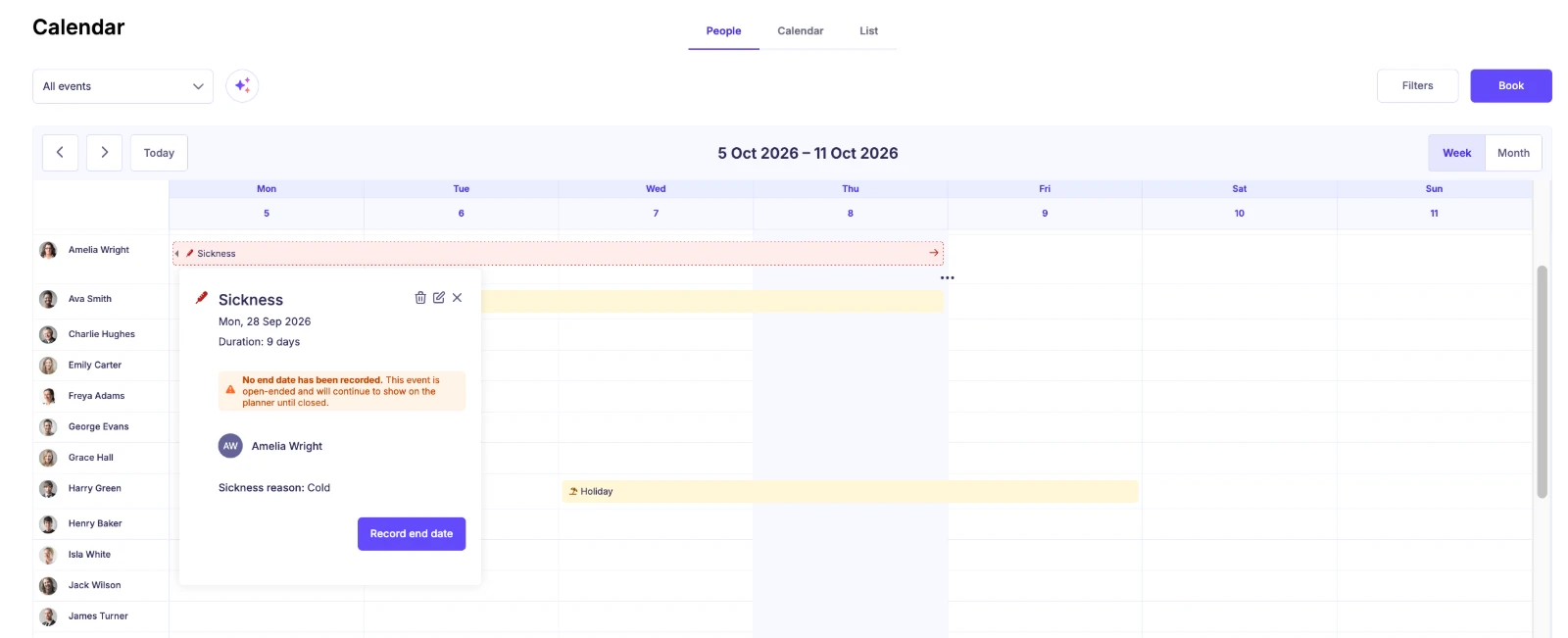
Example: someone leaves halfway through a shift
An employee feels unwell and goes home during the afternoon.
The administrator can record the time or part of day when the absence began, using the applicable Sickness setup. If the employee cannot say when they will return, the absence can be left open rather than given a speculative End date.
When the return is known and recorded, the same absence record provides the continuity of the case.
The value is practical. Managers know the absence is still active. HR has one record to review. Nobody needs to remember which placeholder date was last used.
More accurate records for phased returns
A return to work is not always an immediate return to normal hours.
Some people gradually increase their working time. Three-quarter-day Sickness is available as a booking option, which is useful when somebody is only working part of each day.
The appropriate arrangement still depends on the employee’s circumstances, workplace policy and any necessary advice. Software records the arrangement; it does not determine what a safe return should look like.
Fit notes and Return to Work: connected to the absence
Capturing dates is only part of an absence process. Teams also need clarity over what actions follow.
In Sense HR 7.0, each Sickness reason can be configured for whether a Fit note is required, whether Return to Work applies and whether the absence is Paid. Sense HR can raise a Fit note required To Do, while a completed Return to Work form can be opened from the Sickness record it relates to.
This helps HR see the record and the corresponding tasks together, rather than using the absence calendar as a reminder system on its own.
For the UK rules and employer process, see Sense HR’s separate Fit Note After 7 Days guide. That legal and policy topic deserves its own explanation.
Why recording the first and last working time matters
An employee who leaves at 2pm has not necessarily missed an entire scheduled shift. Similarly, an employee returning for only part of a day may have a different absence duration from somebody off all day.
Using Part of day or Time-based Sickness, where configured, helps the recorded duration reflect the actual time away. HR should review how the organisation’s working hours and Standard working day fallback are set before relying on duration calculations.
A good record supports conversations, reporting and follow-up. It should not substitute for checking employee welfare or applying a consistent sickness policy.
Questions to ask of your absence management system
Can it record sickness with no known end? Can it preserve one absence case until the return is recorded? Can it handle somebody leaving halfway through a shift? Are fit note requirements and Return to Work actions attached to the relevant record? Can managers see outstanding sickness cases without asking HR for a manual list?
Those are more revealing questions than simply asking whether a product has an absence calendar.
Frequently asked questions
Does open-ended sickness mean the absence is never closed?
No. It means an End date is not required at the outset. The absence remains open until the return is recorded.
Does Sense HR support sickness shorter than one day?
Yes. Sense HR 7.0 supports half-day, quarter-day and Time-based Sickness, depending on configuration.
Are fit notes and Return to Work handled automatically?
Sense HR 7.0 includes configurable Fit note and Return to Work settings for each Sickness reason, a Fit note required To Do and access to a completed Return to Work form from the related sickness record. The precise process should be configured and checked against your organisation’s policy.
Stop inventing return dates
When somebody is unwell, their manager and HR team already have important work to do. Managing a series of made-up dates should not be among those tasks.
Learn more about Sense HR Absence Management or request a walkthrough of an open-ended sickness case.
This guide is part of our Sense HR 7.0 release series. See everything that’s new in Sense HR 7.0.